Mesh vs Bluetooth Motorcycle Intercom: What Actually Changes on a Group Ride
Mesh and Bluetooth intercoms do the same job in two different ways, and the gap between them only shows up once a third rider joins. For a rider and a passenger, or two friends who stay within sight of each other, a Bluetooth unit does everything that matters and costs considerably less. Past four riders, or on any ride where people drift apart and rejoin, the difference stops being technical and starts being obvious.
This page compares what Asmax, Cardo and Sena actually publish about their mesh systems — rider counts, advertised range, battery, water resistance — and points out where those numbers are not measured the same way.
How Bluetooth intercoms connect riders
Bluetooth intercoms connect through a daisy-chain topology: each unit pairs directly with the unit immediately next to it, forming a single continuous chain. This layout works cleanly when everyone stays in formation, but it introduces a strict dependency across the group.
The practical consequence is immediate: if a rider anywhere in the middle of the chain moves out of range, turns off their unit, or takes a different turn, everyone behind that rider loses connection instantly. When that happens, the group cannot simply carry on talking; riders typically have to pull over and manually re-pair their devices to restore the chain. Standard Bluetooth also enforces strict group limits — for example, Sena publishes a limit of 4 riders on the Bluetooth intercom of the 50S.
How mesh changes the topology
In a mesh network, every device acts as an independent node that simultaneously routes signal to every other reachable unit. Instead of a single brittle line, the network operates as an adaptive web that constantly recalculates communication paths.
When someone leaves the group, falls behind, or switches positions, the mesh reorganizes itself automatically without manual intervention. A rider who gets stuck at a red light and catches up two miles later automatically rejoins the conversation the moment they come back within range. No buttons to press, no stopping at the side of the road, and no manual re-pairing.
It is worth emphasizing that this is purely an architectural difference, not an audio quality upgrade. Mesh does not make the sound clearer or richer; it simply prevents the connection from breaking.
Where the difference actually matters
- Two riders (rider and passenger): Bluetooth handles this completely. Mesh is money spent on a problem you do not have.
- Three to four riders, staying close: Bluetooth still works. The chain breaking becomes an occasional annoyance rather than a real problem.
- Five or more riders: This is where mesh earns its price. Manually repairing a chain of six people at a fuel stop is the exact friction mesh removes.
- Any group that splits and regroups: Touring, mixed paces, riders taking separate routes. Self-healing is the whole point here, regardless of group size.
What the manufacturers publish
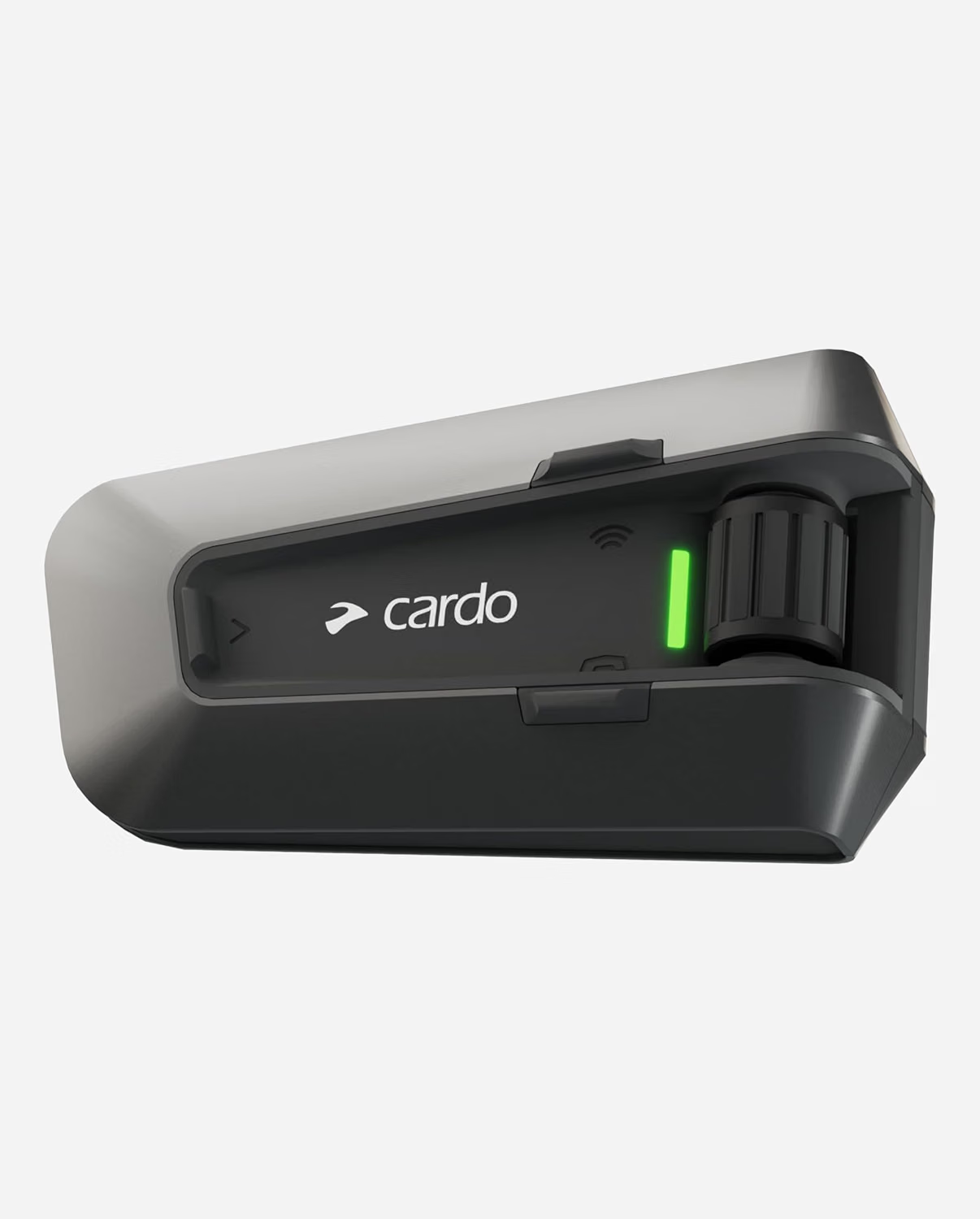
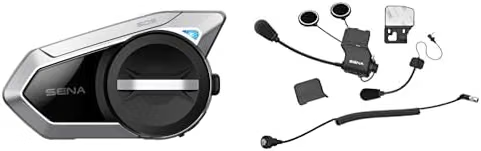
| Specification | Asmax S1 | Asmax F1s | Cardo Packtalk Edge | Sena 50S |
|---|---|---|---|---|
| Technology | Mesh + Bluetooth 5.4, plus CloudTalk cross-network mode | Mesh + Bluetooth, plus ASMAX Mode (mesh/5G switching) | 2nd Gen DMC mesh + Bluetooth 5.2 | Mesh 2.0 + Bluetooth 5.0 |
| Riders (mesh) | 8 | 10 in mesh; up to 50 via app | 15 | 24 in Group Mesh; open mesh virtually limitless |
| Riders (Bluetooth) | Not specified | Not specified | Not specified | 4 |
| Advertised range | Up to 5 miles | 3–8 km | Up to 1 mile (1.6 km) | Up to 1.2 miles (2 km), both mesh and Bluetooth |
| Battery (talk time) | 13 h intercom, 16 h music, 96 h standby | Not specified | 13 h | 16 h Bluetooth intercom, 13 h mesh |
| Fast charge | 10 min for up to 3 h intercom | 10 min for up to 3 h mesh | Yes, USB-C | 20 min for 2 h intercom |
| Water resistance | IPX7 | IP67 | IP67 (dust-tight, 1 m for 30 min) | No IP rating published — marketed as water resistant |
| Speakers | Not specified | 40 mm | 40 mm JBL | Harman Kardon |
| Warranty | 2 years | Not specified | 3 years | Not specified |
| Price | Check current price | Check current price | Check current price | Check current price |
A note on those range numbers. Asmax advertises up to 5 miles while Cardo publishes 1 mile and Sena publishes 1.2 miles. That does not mean the Asmax reaches five times further than a Cardo. Manufacturers do not measure range the same way — some publish the maximum distance across an entire chain of riders in ideal open terrain, others publish the distance between two units. Until brands measure the same thing the same way, treat every range figure as a ceiling set under perfect conditions, not as a number you should expect on a road with hills, trees or buildings.
What the spec sheets do not tell you
- Water resistance is not equally documented. Cardo publishes IP67 and states what it means — dust-tight and submersible to one metre for thirty minutes. Asmax publishes IPX7 on the S1 and IP67 on the F1s. Sena publishes no IP rating at all for the 50S and describes it as water resistant. An unrated claim is not the same thing as a rated one.
- Battery figures are not comparable across modes. Mesh draws more power than Bluetooth. Sena publishes both numbers separately (16 hours Bluetooth, 13 hours mesh); brands that publish a single figure may be quoting the more favourable mode.
- Cross-brand communication is a moving target. Asmax publishes a CloudTalk mode for talking to other brands through its app. Cardo and Sena mesh networks are proprietary and do not interoperate with each other in mesh mode — cross-brand usually falls back to a standard Bluetooth pairing, with the group limits that come with it.
- Even one brand's own rider count is not consistent. Cardo's spec comparison for the Packtalk Neo and Edge states 15 riders on 2nd Generation DMC. The retail listings for the same units describe intercom for up to 31 riders. Both figures come from Cardo. Where a brand publishes two numbers for the same product, the lower one is the safer planning assumption.
Frequently asked questions
Can I use a mesh intercom with someone who has Bluetooth only?
Usually yes, but through a standard Bluetooth pairing rather than the mesh network — which means you inherit the Bluetooth limits, including the chain breaking. Asmax publishes a CloudTalk mode intended to connect across brands through its app.
Do mesh intercoms drain the battery faster?
Yes. Sena publishes 16 hours on Bluetooth intercom against 13 hours on mesh for the same unit, which is a reasonable indication of the gap.
Do mesh networks from different brands talk to each other?
Not in mesh mode. Cardo DMC and Sena Mesh are separate proprietary systems. Mixed groups generally fall back to Bluetooth.
Is a higher advertised range always better?
No, because the figures are not measured consistently between brands. See the note under the comparison table.
Bottom Line
If you ride with one other person, buy Bluetooth and spend the difference on something else. The chain problem mesh solves does not exist at two riders.
If you ride in groups of five or more, or if your group splits up and rejoins during a ride, mesh is the feature you are actually paying for, and it is worth paying for. Within mesh, the published rider counts differ substantially — 8 on the Asmax S1, 15 on the Cardo Packtalk Edge, 24 in Sena's Group Mesh — so match the number to the size of the group you actually ride with, not the largest group you can imagine.
What no spec sheet will settle is real-world range, because none of these numbers are measured the same way. Buy on rider count, battery and documented water resistance, and treat every range figure as a ceiling.